

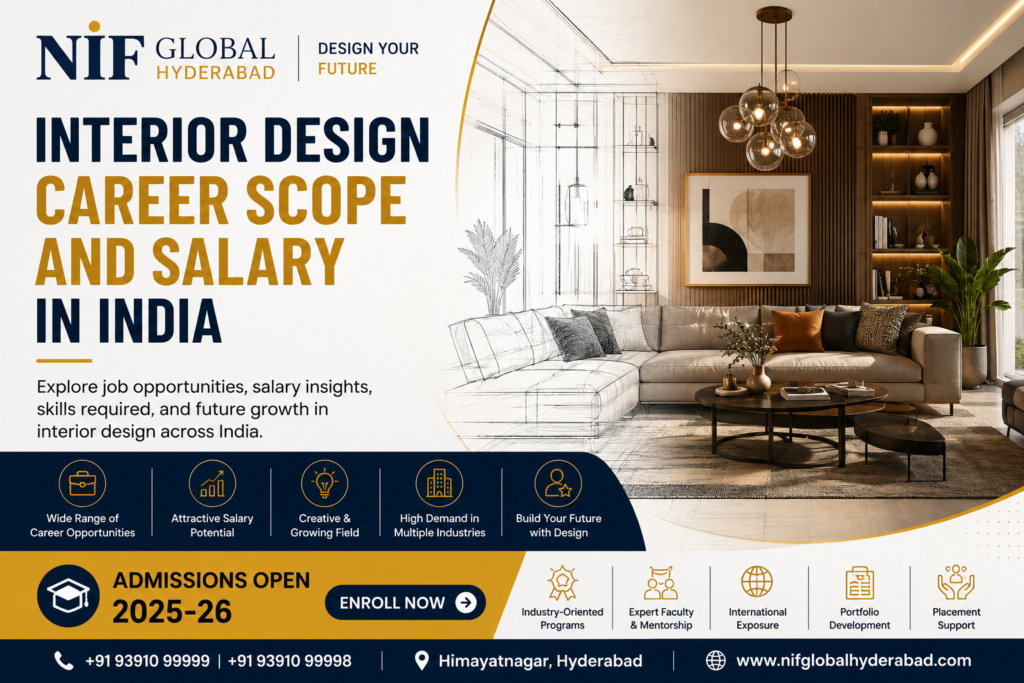
Interior Design Career Scope and Salary in India
Interior Design as a Professional Career
Interior design has moved far beyond choosing wall colours, furniture, curtains, or decorative pieces. Today, it is a professional field that combines creativity, space planning, technical knowledge, lifestyle understanding, material awareness, budgeting, sustainability, client handling, and design execution.
Every home, office, retail store, café, hotel, studio, showroom, and commercial space needs thoughtful design. People no longer want spaces that only look good. They want spaces that feel comfortable, function well, reflect their personality, and support the way they live or work.
This is one of the biggest reasons why interior design has become a serious career choice in India. For students who are creative, observant, detail-oriented, and interested in spaces, colours, materials, furniture, lighting, and layouts, interior design can offer a meaningful and future-ready career path.
The interior design market in India is also growing strongly. Industry reports estimate India's interior design market at around USD 36.89 billion in 2025, with projections of continued growth over the next decade. Another market estimate projects India's interior design market to grow from USD 35.48 billion in 2026 to USD 65.01 billion by 2031.
This growth is creating demand for trained interior designers who can work on residential, commercial, retail, hospitality, and lifestyle spaces.
Why Interior Design is Becoming a Popular Career in India
India is changing fast. Urban homes are becoming more compact. Families want better space utilisation. Young professionals want modern apartments. Businesses want attractive offices. Retail brands want experience-driven stores. Hotels and cafés want Instagram-worthy interiors. Real estate developers want sample flats and furnished spaces. Even small homeowners now look for modular kitchens, smart storage, lighting plans, and personalised room design.
This shift has made interior design more important than ever. Earlier, many people treated interior design as a luxury. Today, it is becoming a practical need. Good design can improve comfort, functionality, storage, productivity, mood, and lifestyle.
Interior designers help people answer questions like:
- How can a small room look spacious?
- How should furniture be placed for better movement?
- Which colours suit the purpose of the room?
- How can lighting change the mood of a space?
- Which materials are durable and budget-friendly?
- How can storage be improved without making the space look heavy?
- How can a commercial space attract more customers?
- How can a home reflect the personality of the family?
This is why interior design is not just decoration. It is problem-solving through design.
Career Scope of Interior Design in India
The career scope of interior design in India is wide because designers are needed in many sectors. A trained interior designer can work with design studios, architecture firms, real estate companies, furniture brands, modular kitchen companies, luxury home companies, retail brands, hospitality businesses, event companies, and independent clients.
Interior design students can explore careers in:
- Residential interior design
- Commercial interior design
- Retail space design
- Hospitality interiors
- Office space planning
- Furniture design
- Modular kitchen design
- Lighting design
- Set design
- Exhibition design
- Visual merchandising
- Space styling
- Design consultancy
- Freelance interior projects
- Interior entrepreneurship
This variety makes the field attractive for students because they are not limited to one type of job. Some students enjoy designing homes. Some are drawn towards cafés, boutiques, and retail stores. Some prefer office planning. Some love furniture and product design. Some are good at styling and presentation. Some want to start their own interior design studio.
A good interior design course helps students understand these directions and choose the path that suits their strengths.
Interior Design Career After 12th
Many students ask whether they can pursue interior design after 12th. The answer is yes. Interior design can be a good option after 12th for students who enjoy creativity, drawing, spaces, home styling, colours, layouts, décor, furniture, and visual thinking.
Students from different academic backgrounds can enter this field if they are willing to learn and practise.
To succeed in interior design, students need:
- Creativity
- Observation
- Patience
- Drawing and visualisation skills
- Space understanding
- Attention to detail
- Material knowledge
- Communication skills
- Client handling ability
- Technical learning mindset
- Interest in lifestyle and design trends
Interior design is not only for students who are already excellent at drawing. Drawing and presentation skills can improve with training. What matters more is curiosity, discipline, practical thinking, and the willingness to learn how spaces work.
At NIF Global, interior design courses include degree programmes such as B.Des in Interior Design, B.Voc in Interior Design, and M.Voc in Interior Design through its wider academic ecosystem. For students in Hyderabad, NIF Global Hyderabad positions itself as an institute for fashion and interior design education with career-focused learning and international exposure.
Interior Designer Salary in India
Interior designer salary in India depends on many factors. There is no single fixed salary for every designer because income changes based on city, skill level, portfolio, experience, project type, company, client handling ability, and whether the designer is working in a job, freelance model, or own business.
In general, beginners may start with entry-level salaries while they gain practical exposure. Salary ranges improve with experience, software skills, portfolio quality, site knowledge, and project handling ability.
A common entry-level range shared by industry education sources is around ₹15,000 to ₹25,000 per month for interior designers with limited experience. With stronger experience and project responsibility, senior designers and design project managers can earn significantly higher packages, depending on role and city.
To understand salary better, students should look at interior design career levels.
Entry-Level Interior Designer Salary
Entry-level interior designers usually work under senior designers, architects, design studios, furniture brands, or interior firms. At this stage, the main goal is learning.
Freshers may assist with:
- Basic drawings
- Mood boards
- Material selection
- Client presentations
- Site visits
- Vendor coordination
- Furniture layouts
- Design research
- Software drafting
- Project documentation
The salary may not be very high in the beginning, but the learning is extremely valuable. Students who take this phase seriously can grow faster. A strong portfolio, software knowledge, communication skills, and internship experience can help freshers get better starting opportunities.
Mid-Level Interior Designer Salary
After gaining a few years of experience, designers usually start handling more responsibility. They may interact with clients, manage parts of a project, create design concepts, coordinate with vendors, supervise execution, and prepare detailed presentations.
At this level, income can improve because the designer is no longer only assisting. They are contributing directly to project planning and execution.
Mid-level designers may work as:
- Interior Designer
- Design Consultant
- Space Planner
- Furniture Designer
- Modular Kitchen Designer
- Project Coordinator
- Site Designer
- Client Presentation Designer
Designers who are confident with software tools, budgets, materials, timelines, and client communication usually grow faster at this stage.
Senior Interior Designer and Project Manager Salary
Senior interior designers handle complete projects, teams, clients, vendors, timelines, site issues, material decisions, and final execution quality. They may work with premium residential clients, commercial projects, hospitality spaces, or larger interior firms.
At this level, income can be significantly higher because the role involves leadership and accountability.
Senior designers may work as:
- Senior Interior Designer
- Design Lead
- Project Manager
- Interior Consultant
- Studio Manager
- Design Entrepreneur
- Creative Head
- Space Planning Specialist
Designers at this level earn more when they combine creativity with execution, team management, budgeting, and client trust.
Freelance and Business Income in Interior Design
Interior design also offers strong earning potential for freelancers and entrepreneurs. Many designers start with small projects such as bedrooms, kitchens, living rooms, home makeovers, office cabins, salons, boutiques, or cafés. Over time, they build referrals, social media presence, vendor networks, and client trust.
Freelance income depends on:
- Project size
- Design fee
- Execution involvement
- Client budget
- Location
- Experience
- Portfolio
- Marketing skills
- Vendor network
- Personal brand
Some designers charge per room, some charge per square foot, some charge a design consultation fee, and some work on complete project execution. This is why interior design is a good field for students who want both job opportunities and future business possibilities.
Popular Job Roles After Interior Design Course
Interior design students can explore several job roles after completing their course. Some roles are creative, some technical, some execution-based, and some client-facing.
Common career roles include:
- Interior Designer
- Assistant Interior Designer
- Junior Designer
- Space Planner
- Design Consultant
- Furniture Designer
- Modular Kitchen Designer
- Lighting Consultant
- Visual Merchandiser
- Set Designer
- Exhibition Designer
- CAD Designer
- 3D Visualiser
- Site Supervisor
- Project Coordinator
- Material Consultant
- Interior Stylist
- Freelance Designer
- Design Entrepreneur
Students should not worry if they do not know their exact role at the beginning. A good course helps them discover what they enjoy most.
Skills Required for a Successful Interior Design Career
Interior design is a skill-based profession. A degree or certificate is useful, but real growth depends on practical ability.
Important skills include:
- Space planning
- Colour theory
- Material knowledge
- Furniture layout
- Lighting understanding
- Technical drawing
- Design software knowledge
- Client communication
- Budget understanding
- Vendor coordination
- Site supervision
- Presentation skills
- Problem-solving
- Trend awareness
- Creativity
- Professional discipline
Students should also learn to think from the user's perspective. A room may look beautiful in a drawing, but if it is uncomfortable to use, it is not good design. Good interior designers balance beauty and function.
Importance of Software Skills in Interior Design
Modern interior design requires software knowledge. Students should be comfortable with digital tools because clients and companies expect visual presentations.
Interior design students should learn tools used for:
- 2D layouts
- 3D visualisation
- Mood boards
- Furniture plans
- Lighting plans
- Material presentations
- Client presentations
- Working drawings
Software knowledge can help students present ideas professionally and work faster. However, software alone does not make someone a designer. It is only a tool. The real design thinking comes from understanding space, function, proportion, materials, and user needs.
Residential Interior Design Scope
Residential interior design is one of the most popular career areas in India. Homes are becoming more design-conscious. People want better kitchens, wardrobes, storage, lighting, living rooms, children's rooms, home offices, balconies, and pooja spaces.
Residential designers work on:
- Apartments
- Villas
- Independent homes
- Studio apartments
- Luxury homes
- Rental home makeovers
- Modular kitchens
- Wardrobes
- Bedroom design
- Living room design
- Home office design
The residential interiors market is growing because more people want personalised, functional, and stylish homes. Recent industry coverage has also highlighted rising consumer demand in home interiors and projections for strong growth in India's home interiors market.
This makes residential design a strong career path for students.
Commercial Interior Design Scope
Commercial interior design includes offices, retail stores, salons, restaurants, cafés, showrooms, clinics, studios, and workspaces. Commercial clients usually want spaces that support business goals.
- A café should attract customers.
- An office should improve productivity.
- A retail store should guide customer movement.
- A clinic should feel clean and trustworthy.
- A showroom should highlight products.
- A salon should feel stylish and comfortable.
Commercial interiors require understanding of branding, customer behaviour, layout planning, lighting, materials, and business functionality. This career path is suitable for students who enjoy practical design and business thinking.
Hospitality and Retail Design Scope
Hotels, resorts, restaurants, cafés, boutiques, and retail stores depend heavily on interiors. Their design affects customer experience, brand image, photographs, reviews, and repeat visits. Hospitality and retail design can be exciting for students who love storytelling through spaces.
Designers in this field work on:
- Hotel rooms
- Lobbies
- Restaurants
- Cafés
- Boutiques
- Retail displays
- Experience centres
- Pop-up stores
- Showrooms
- Luxury spaces
This field requires strong visual taste, theme development, material selection, lighting, and customer experience understanding.
Interior Design and Entrepreneurship
Interior design is one of those fields where students can eventually start their own business. After gaining experience, designers can launch:
- Interior design studio
- Home styling service
- Furniture design brand
- Modular kitchen consultancy
- Décor store
- Online design consultation service
- Turnkey interiors business
- Boutique space design studio
- Home renovation service
Entrepreneurship requires more than creativity. Designers must also learn pricing, client handling, vendor coordination, project timelines, marketing, budgeting, and negotiation. Students who want to start their own design business should focus on both design skills and business understanding.
Why Study Interior Design at NIF Global Hyderabad
For students searching for an interior design institute in Hyderabad, NIF Global Hyderabad offers a creative learning environment for design aspirants. The institute is positioned around fashion and interior design education, trained faculties, international exposure, and career-oriented learning.
Students can consider NIF Global Hyderabad for:
- Interior design learning
- Fashion and design ecosystem
- Practical design education
- Trained faculty support
- International certificates
- Exposure to design platforms
- Career-focused guidance
- Creative student community
- Campus facilities in Himayatnagar
- Design portfolio development
Interior design students need an environment that encourages creativity and discipline together. NIF Global Hyderabad can be considered by students who want to start their creative journey in Hyderabad and explore design as a serious career.
Future of Interior Design in India
The future of interior design in India looks promising because of urbanisation, rising lifestyle aspirations, real estate growth, modular furniture demand, smart homes, premium retail, hospitality expansion, and design-conscious customers.
Interior design is also changing with technology. Future designers will need to understand:
- Smart homes
- Sustainable materials
- Space-saving furniture
- Digital presentations
- Virtual walkthroughs
- Lighting automation
- Eco-friendly design
- Work-from-home spaces
- Multifunctional rooms
- Personalised interiors
Students who learn both creative and technical skills will have better opportunities in the coming years. Interior design will continue to need human creativity, empathy, cultural understanding, and practical problem-solving.
How Students Can Build a Strong Interior Design Career
Students who want to grow in interior design should begin early. They should:
- Practise sketching and visualisation
- Observe homes, cafés, stores, and hotels
- Build a design portfolio
- Learn software tools
- Understand materials and finishes
- Take internships seriously
- Visit sites whenever possible
- Learn client communication
- Create mood boards regularly
- Follow Indian and global design trends
- Improve presentation skills
- Build professional discipline
- Ask questions and keep learning
Interior design rewards students who are consistent, curious, and practical. A designer's growth depends on how much they observe, practise, and improve.
Final Thoughts
Interior design offers strong career scope in India because people and businesses are investing more in beautiful, functional, and personalised spaces. From homes and offices to cafés, hotels, stores, studios, and showrooms, trained interior designers are needed across many sectors.
Salary in interior design depends on skills, experience, portfolio, city, role, and project exposure. Beginners may start with entry-level salaries, but with strong skills and practical experience, designers can grow into senior roles, freelance work, or their own design business.
For students in Hyderabad, this is a good time to enter the field. If you are creative, observant, and interested in transforming spaces, an interior design course can help you build the right foundation.
Admissions Open at NIF Global Hyderabad. Start your creative journey in interior design and build a career that shapes the way people live, work, and experience spaces.
FAQs
1. What is the career scope of interior design in India?
2. What is the salary of an interior designer in India?
3. Can I pursue interior design after 12th?
4. What job roles are available after an interior design course?
5. Is interior design a good career for creative students?
6. What skills are required for interior design?
7. Why choose NIF Global Hyderabad for interior design?
8. Can interior designers start their own business?
9. Is software knowledge important for interior design?
10. How do I start a career in interior design in Hyderabad?
Want to Know the Fees & Admission Process?
Speak to our counsellor and get complete details about fashion designing course fees, eligibility, syllabus and admission process.
